
Oak Lawn Epoxy Flooring installs polyaspartic floor coating systems in Oak Lawn, IL, serving surrounding cities including Chicago Ridge, Evergreen Park, Worth, Alsip and Bridgeview. With 20+ years of concrete coating behind us, we use polyaspartic where its speed, color stability and toughness genuinely help the floor, and we explain plainly where an epoxy base or another system is the better fit.
Polyaspartic is a fast-curing relative of polyurea. It reaches walk-on hardness in hours rather than a day, stays clear under ultraviolet light, and cures across a broader temperature range than most epoxies. Those strengths make it the topcoat of choice on many garage and commercial floors, but its quick cure also makes it unforgiving of rushed preparation.
That is why our method does not change with the product. Every slab is diamond ground or shot blasted, tested for moisture and repaired before the first coat, and the proposal names the polyaspartic product line, the number of coats and the finished thickness, so you can check the floor against the quote after it is installed.
Where Polyaspartic Coatings Earn Their Place
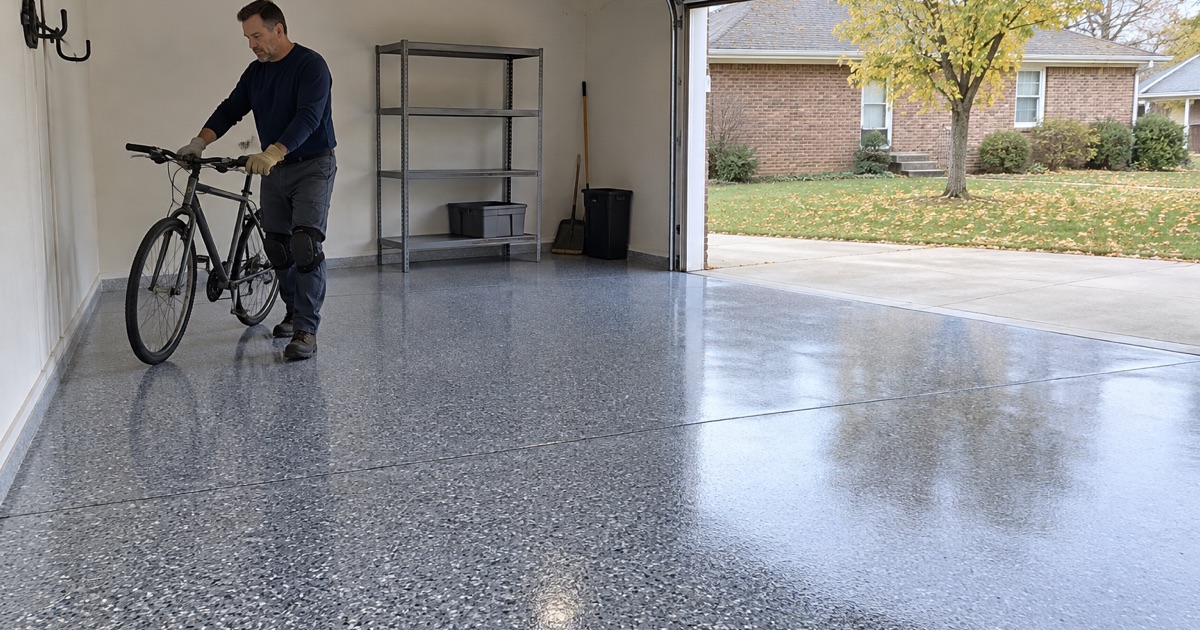
Garages Where the Door Stays Open
A garage floor sees direct sun every time the door goes up, and standard epoxy ambers along that sunlit strip over a few seasons. Aliphatic polyaspartic topcoats resist that yellowing, so a light gray or flake floor stays the color you picked rather than turning tan across the front third of the garage.
Polyaspartic also stands up well to the road salt and calcium chloride brine that ride in on tires through an Illinois winter. A tight, chemical-resistant topcoat keeps those chlorides on the surface, where they can be squeegeed out of the door, instead of letting them into the concrete where freeze-thaw cycles scale the slab.
Showrooms, Stores and Businesses That Cannot Close
For a business, the main appeal is downtime. A polyaspartic system can be installed overnight or across a weekend and returned to foot traffic quickly, which matters to a retail store, a dealership showroom or a clinic that loses money for every day the floor is closed.
We phase those jobs around opening hours, coating one area while another stays in use, and we pick products with odor and cure times that fit the reopening deadline. The schedule is agreed in writing before work begins, so the store manager knows exactly which zones will be closed and when.
Cold-Season and Shoulder-Season Work
Polyaspartic cures at lower slab temperatures than many epoxies, which widens the installation season for garages and unheated spaces. That does not mean any temperature works, though. We still measure the slab and the dew point spread at the surface, because a coating applied too close to the dew point traps moisture under the film.
An unheated garage in the depth of winter is still asked to wait or to heat the space ahead of the install. The broader cure range buys a few extra weeks in spring and fall; it does not turn a frozen slab into a good substrate.
On cool days we also watch for condensation on the slab once the garage door opens in the morning. A thin film of moisture that is invisible to the eye is enough to spoil adhesion, so the readings are taken at the surface right before mixing, not once at the start of the day.
How We Build a Polyaspartic Floor System
Mechanical Preparation to a Real Profile
The fast cure gives polyaspartic very little time to soak into the concrete, so the profile the coating grips has to be right. We grind or shot blast to the ICRI concrete surface profile the manufacturer specifies, removing sealers, paint, oil-soaked paste and any loose surface layer.
Acid etching is never used. It leaves an uneven, shallow profile and does nothing to sealers or old coatings, and a fast-curing coating applied over that kind of surface has even less chance than a slow epoxy to find a bond.
Moisture Testing and Primers
Moisture coming up through the slab is the leading cause of coating failure and the first exclusion in most coating warranties. We test before pricing, using a plastic sheet test or a calcium chloride emission test, and in-situ relative humidity probes when a basement or slab-on-grade floor needs a closer look.
When readings are high, a moisture-mitigation primer goes down first, or we recommend against coating until the source is addressed. Polyaspartic is excellent at many things, but it cannot hold back vapor pressure on its own.
Base Coats, Broadcasts and Topcoats
Many of our systems use a 100% solids epoxy or polyaspartic base coat, a vinyl flake or quartz broadcast, and a clear polyaspartic topcoat. The base builds thickness and fills the profile, the broadcast adds texture and hides slab blemishes, and the topcoat seals the chips and carries the UV and chemical resistance.
Coat count and thickness are named in the proposal, along with the broadcast type and any anti-slip additive in the topcoat. Two quotes for a polyaspartic floor can be very different floors, and those lines are where the difference shows.
Texture, Grip and Sheen
A smooth polyaspartic topcoat is very hard and very easy to clean, but it can be slick under melting snow or spilled fluids. We add a fine aggregate to the topcoat in walk paths, on garage aprons and around commercial entries, so the floor keeps its grip when it is wet without becoming hard to mop.
Sheen is chosen at the same time. High gloss shows off a metallic or flake blend but also highlights dust and tire marks, while a satin topcoat hides everyday wear and still cleans easily. We show both on a sample board under your own lighting before the topcoat is ordered.
Edges, Drains and Transitions
The edges of a floor are where coatings tend to fail first, especially at the garage door where meltwater collects and at floor drains in commercial spaces. We cut a clean termination at the slab edge, key the coating into the concrete there, and finish neatly around drains and expansion joints so water cannot work under the film.
Transitions to other flooring get the same care. Where the coating meets carpet, tile or a doorway threshold, we plan the edge so it sits flush and does not leave a lip that catches carts or toes.
Choosing Between Polyaspartic, Epoxy and Polyurea
When Polyaspartic Is the Right Topcoat
Polyaspartic is the right topcoat for floors in sunlight, floors that must return to service fast, and garages that see hot tires and winter brine. Its hardness and chemical resistance make it a strong wear layer, and its clarity keeps flake blends looking crisp for years.
It is also a good match for owners who simply do not want the garage out of use for a week. A fast-curing topcoat shortens the time between the last coat and parking the car, as long as the slab temperature cooperates.
When Epoxy Still Makes Sense
A 100% solids epoxy base coat is often the better foundation underneath, because it penetrates the profile well, builds thickness economically and gives the crew more working time on large floors. Basement floors away from sunlight may not need a UV-stable topcoat at all.
We will not upsell an all-polyaspartic system where an epoxy base would do the job. The recommendation follows the slab, the light, the traffic and the schedule, and the proposal explains the choice in plain words.
What a Polyaspartic Floor Costs
Price depends on square footage, repair work, moisture mitigation, the broadcast chosen and the number of coats. Polyaspartic materials cost more than standard epoxy, and the short working time calls for an experienced crew, which is part of why the price differs from a kit or a single-coat roll-on.
Home jobs above the Illinois Home Repair and Remodeling Act threshold get a written contract and the consumer-rights pamphlet before we start, and we explain the warranty exclusions, moisture first, before you sign. That way the price, the floor and the warranty all describe the same job.
- 20+ Years Coating Concrete
- Moisture Tested Before Pricing
- Free Written Estimates