
Oak Lawn Epoxy Flooring installs ESD flooring in Oak Lawn, IL, serving surrounding cities including Chicago Ridge, Evergreen Park, Worth, Alsip and Bridgeview. With 20+ years of preparing and coating concrete, we build static-dissipative and conductive epoxy floors for electronics assembly, labs, server rooms and other spaces where a static discharge can damage equipment or products.
Electrostatic discharge is the small spark you feel after walking across a carpet. To a person it is harmless; to a circuit board, a sensor or a hard drive it can be enough to cause hidden damage that fails in the field weeks later. An ESD floor gives that charge a controlled path to ground, so people and carts moving across the room do not build up a dangerous voltage.
Because an ESD floor is a working part of a static control program, it has to be designed, installed and tested to a specification. Our proposals name the product system, the resistance range it is designed to meet, the grounding layout and the testing that will be done after installation.
How ESD Flooring Works
Conductive and Static-Dissipative Ranges
Static-control floors are classed by how easily they let charge flow. The ANSI/ESD S20.20 standard sets an upper limit on floor resistance for electronics handling areas, and floors are generally described as conductive at the low end of resistance and static-dissipative across the range above it, up to that limit.
Which range you need depends on the components being handled, the footwear in use and your facility’s own static control plan. We work from the specification your quality or engineering team provides, and help interpret it when the floor is part of a new program.
The Floor, Footwear and People as One System
An ESD floor does not work on its own. The standard looks at the floor and footwear together, measuring how much voltage a person can build up while walking. The goal is to keep that body voltage below 100 volts in electronics handling areas.
That means footwear matters as much as the floor. Staff wear ESD shoes or heel straps, and visitors need heel grounders. We explain these requirements before installation so the floor is part of a complete plan.
Conductive Primers and Grounding Points
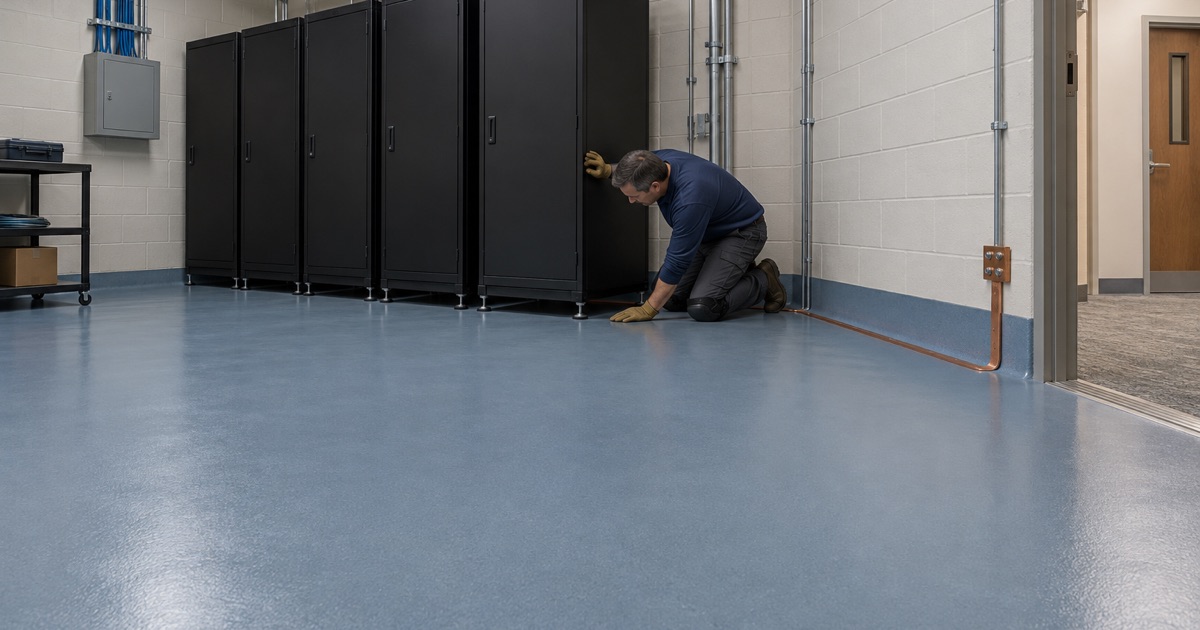
Most ESD epoxy systems start with a conductive primer over the prepared slab, with copper grounding strips laid at intervals and connected to building ground. The ESD topcoat contains conductive fibers or fillers that carry charge from the surface down to that primer layer.
Grounding points are planned with your electrician or facilities team, and their locations are recorded. A floor that is not properly connected to ground cannot drain charge, no matter what the coating contains.
Where ESD Floors Are Used
Electronics Assembly and Repair
Electronics manufacturers, repair shops and assembly lines handle components that can be damaged by discharges far too small to feel. ESD floors protect work areas, aisles and storage rooms where boards and components move between stations.
We also look at carts, chairs and workstations, because wheels and casters need conductive materials to make use of the floor. A cart with insulating wheels rolling across an ESD floor still carries its charge with it.
Server Rooms and Data Closets
Server rooms and telecom closets hold equipment that is costly to replace and critical to keep running. A static-dissipative floor reduces the risk of discharge when technicians handle drives, cards and cabling.
These spaces often cannot be shut down for long, so we plan the work around maintenance windows and use systems with manageable cure times. Dust is captured at the grinder to protect nearby equipment.
Labs, Clean Spaces and Sensitive Storage
Laboratories, medical device areas and rooms that store sensitive instruments may need ESD flooring alongside chemical resistance and easy cleaning. Seamless epoxy systems meet those needs while carrying charge to ground.
Some areas also handle flammable vapors or powders, where static control is a safety concern as well as a product concern. Those spaces follow their own standards, and we build to the specification provided.
Installing and Testing an ESD Floor
Preparation and Moisture Testing
ESD systems depend on a consistent bond and a consistent layer thickness, so preparation is especially important. We diamond grind or shot blast the slab to the specified concrete surface profile and repair cracks and spalls before priming.
Moisture can affect both adhesion and electrical properties, so we test before pricing using calcium chloride or in-situ relative humidity methods. High readings call for a moisture-mitigation primer that is compatible with the conductive layers.
Testing After Installation
Once cured, the floor is tested for resistance at multiple points using the methods the standard calls for. We record the readings and share them with your team as a baseline for periodic verification.
Regular testing over time confirms that the floor is still performing as cleaning, wear and contamination take their toll. We can return to retest or advise on how your own team can run checks.
Cleaning and Long-Term Care
Some common cleaners, waxes and finishes leave insulating films that block the path to ground. ESD floors should be cleaned only with products approved for static-control flooring, and never waxed with ordinary finishes.
We leave written care instructions and a list of products to avoid. Keeping the floor clean and free of insulating residue preserves its performance for years.
Planning Your ESD Floor
Compliance, VOCs and Paperwork
Illinois limits VOC content in floor and industrial maintenance coatings, and those rules apply to the applicator, so every ESD system we install is chosen within them. Illinois has no state flooring license, so we confirm the village’s registration and insurance requirements before booking, and provide certificates to owners and property managers.
Scheduling and Cost Drivers
ESD floors cost more than standard commercial coatings because they add conductive primers, grounding strips, specialized topcoats and post-installation testing. Floor area, slab condition, moisture mitigation and the resistance range required all move the price, and each appears as its own line in the proposal.
Work in operating facilities is phased around production schedules, often across weekends or planned shutdowns. We agree the sequence, the cure times and the date of the resistance testing in writing, so equipment can be moved back onto a floor that has already been verified.
- 20+ Years Coating Concrete
- Moisture Tested Before Pricing
- Free Written Estimates